
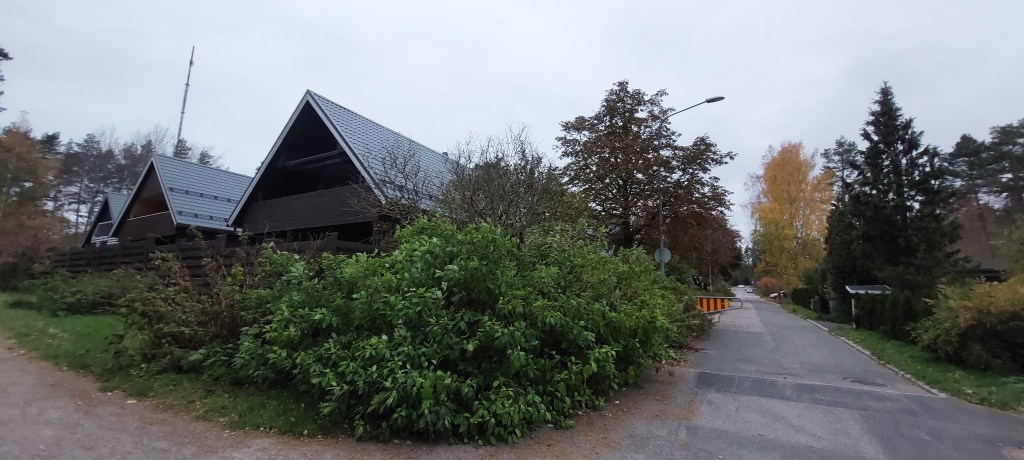
It never ceases to puzzle me, how the Finnish people who normally value their own personal space and serenity, can live in close proximity to others in Apartments and co-operative run neighbourhoods. Out on the street it is not considered normal to say, “good day!” to passing folk or even neighbours. At the bus stop Finns keep a good space between each person in the queue, which made the Covid distancing easier here. It’s not normal to just drop in on a neighbour or acquaintance, yet the Finns seem good at working together for the common good of the local area and their own housing situation.
As an owner of an Apartment, you have shares in the Limited Company that owns and runs the building. Buying such a property involves making a market value offer for the shares that the individual Apartment has in the housing company. A committee of the residents/owners is responsible for the running of the building and surrounding owned gardens and parking area. The committee appoints a professional building maintenance company to do routine maintenance and organise other works. The committee decides on bigger projects such as necessary renovations and improvements and has the power to get the housing company to take out loans for these projects. Apart from internal décor, residents are not responsible for renewing any internal fixtures and fittings, these are all covered by your ownership in the Housing Company which makes an appropriate service charge to cover any current and future maintenance and renovations.
The housing company committee organises Talkoot usually once or twice a year. Talkoot is where the residents get together to tidy up the outside spaces. The main one is in the Autumn to sweep up leaves, trim hedging and remove the associated green waste. A good community spirited Talkoot involves a couple of hours of graft and then beers and sausages around the communal barbeque. A chance for a real chat with the neighbours and saves the housing company having to pay for the tidying.
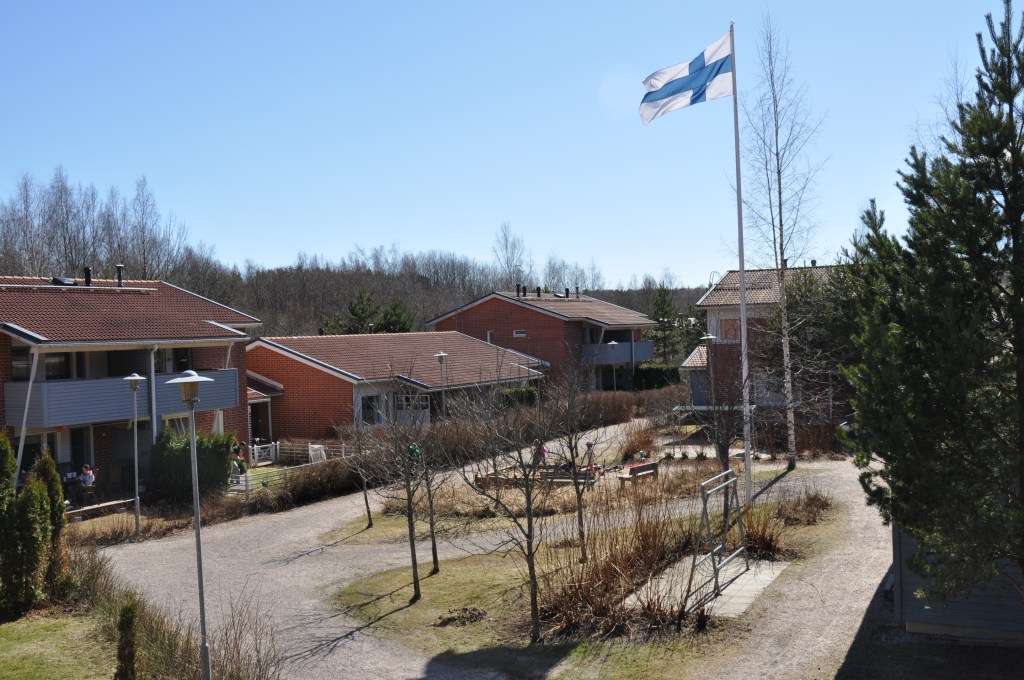
This shares based Housing Company system applies to all Apartments, Terraced, semi-detached, and detached houses where the freehold land is jointly owned by a number of houses. Hence, many Finns have to work together to keep their housing in good condition, and are quite successful at achieving this. However, there is always the odd unconventional neighbour. We often hear about apartment owners complaining about a noisy neighbour. Housing Company conditions of occupancy usually specify hours of quietness between 10 in the evening to 7 in the morning and the majority of people do observe this. A polite notice or chat with the offending neighbour often works. If that doesn’t work, the Housing Company can be approached for further pressure. This works well with rental properties because the tenant can be given notice to quit, but in an owned apartment block, your last resort may be to sell-up and move on.
More recently the Russian neighbour has become the big bad neighbour. Finns have never really trusted the big neighbour since the Soviets invaded in 1939 and following the Second World War, annexed 9% of Finnish territory. Since then, Finland has had to work hard to keep a balance between not offending the Russian leadership and yet wanting to be more Western orientated and thoroughly independent. Finland succeeded at this, being the only country invaded by the Soviets to avoid being dragged into full Soviet control post 1945. As part of the end of war negotiations Finland was forced to accept the territorial losses and the treaty also required Finland to toe the Soviet line. The Soviets also kept a couple of Soviet military bases on the Hanko and Porkkala peninsulas until 1956. Their big guns at Porkkala, only 19 miles West of Helsinki, were referred to being like a ‘gun to the head’. The Finns managed to keep their fully Western market economy and at the same time had preferential trade links with the Soviet bloc because of the treaty.
The relationship between Finland and the big Russian neighbour in some ways mirrors how Finnish people like to be free and independent, but when needs must, can either work well together, or can disengage if the status quo is broken. Since Soviet times, Finnish-Russian business developed greatly, for example, the majority of Nokian tyres were manufactured in Russia. Unfortunately, due to the Russian invasion of Ukraine, Finnish businesses have been selling off their Russian operations to follow sanctions rules. The cross-border trade has dropped significantly to the detriment of the Finnish economy, apart from its effect on the Russian economy. The Finnish-Russian border crossings are closed and Finnish towns near the border are suffering from the loss of trade. That is considered a small cost for defending freedom and democracy. Finns have a long painful memory of dealing with and suffering European autocrats and are prepared for the worst.
 Happy in Finland
Leave a comment