
Surprisingly this sparsely populated country has a few achievements worth noting at the forefront of citizens rights. Finland was one of the first countries to introduce Universal Suffrage and the first Parliament to have elected women members. Finland has a representative democracy but how does this all work and do people actually feel better represented?
Part 4. Freedoms and Other Components of a Full Democracy
Citizen’s Freedoms
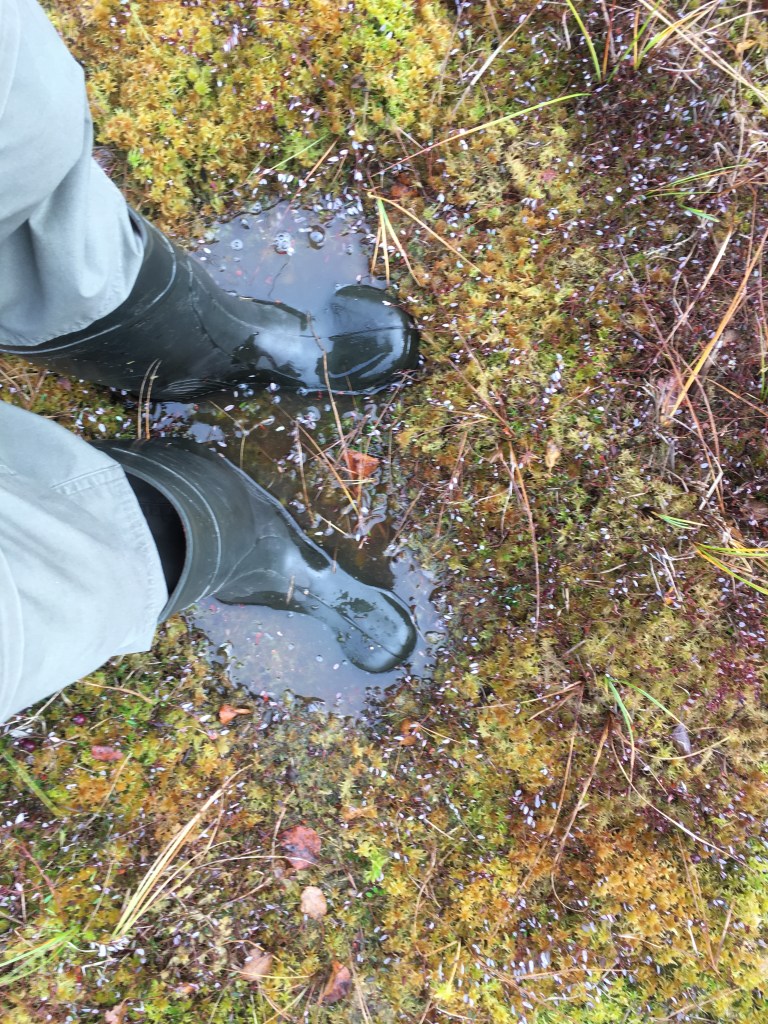
The road to Finnish independence and citizens freedoms was hard won. Finland remains the only country invaded by Soviet Russia during the Second World War to retain its independence, and the only Parliaments that met regularly throughout the conflict were those of the British and Finnish. Hence, Finns value their freedom enshrined in the constitution. The personal freedom of citizens, their financial and health security probably leads to Finland appearing in the polls as the Happiest Country year after year.
Citizens and legal residents of Finland are pleased to travel freely wherever they like. It is possible to roam everywhere apart from private gardens, and certain defence areas. Farmland and forest is accessible but you should not damage the crops and can not harvest wood without the landowner’s permission. Berries and fungi can be freely picked, and many Finns can be found wandering in the forests pursuing their favourite delicacies. People have their own secret areas where they like to find Chanterelle mushrooms or a bog where the rarer Cloudberries grow.
My last employer often asked me if I liked the job. He genuinely valued my contribution but was always concerned that us workers were happy or not. He would say “it’s a free country, you can always leave if you’re not happy”.
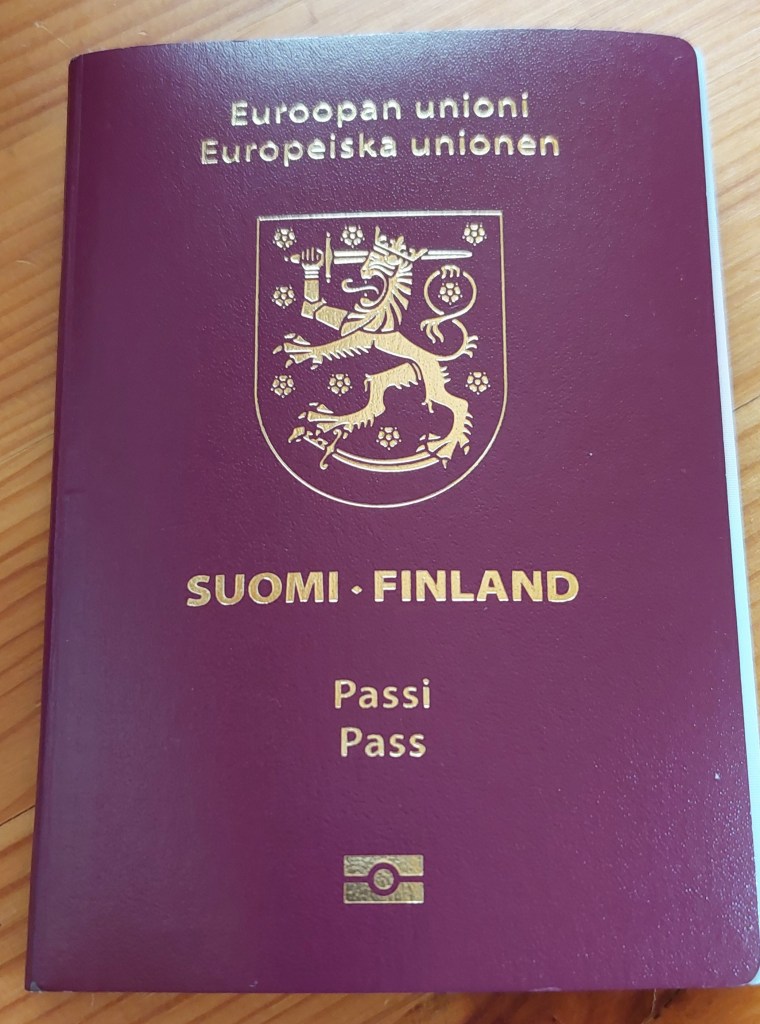
The Finnish Passport gives visa-free access to 192 countries. It is considered one of the most desirable passports in the world with a very high mobility score. Finns may be a small population but are some of the most travelled people in the world. Some years ago it amused my Finnish wife to over-hear 6 Finnish students chatting on the London tube. They were saying how wonderful it was to have their own language that nobody else could understand. As my wife left the train, she said in Finnish with a smile, “I wouldn’t be so sure about that”.
Even on top of the Malvern Hills in Worcestershire, England, Finns can be found. One summer I took my wife up the hills to see the views and during a breather the only person we encountered passed us by. His phone rang to the Nokia ringtone and he answered with a loud “Moi” before disappearing out of our hearing. As far as we are aware, only Finns use Moi as a greeting.
Education
The constitution states that everyone has the right to basic education free of charge. There is also a guarantee for equal opportunity to receive other educational services in accordance with ability and special needs, as well as the opportunity for people to develop themselves without being prevented by economic hardship. In practice all Finnish schools are state maintained. There is no other tier of private schools apart from the few International Schools. This ensures that all parts of society share schooling and the curriculum is standardised and very well delivered for all. All State education from pre-school to higher education is free of charge.
When on the integration programme, with my educational experience I took my language practice in one of the local Primary Schools, and saw a typical school in action for a few months. There is the curriculum to follow according to the age and ability of the children, but all the teachers have the freedom to manage and teach as they see fit. Generally the children were very well behaved, attentative and pleased to be there. Even the rebellious kids were obliging and knuckled down to completing the given tasks. This behaviour, instilled by parents and attendance at pre-school care, means that Finnish children are ready to start school properly at age 7.
The freedom of science, the arts and higher education is also guaranteed in the Constitution.
Pregnancy and Parent’s Rights
Generous parental leave gives Finns job security and the freedom to start a family. The parents can get 320 days leave for the birth of a child. Some of you may already have heard of the famous Baby Box issued to all expectant Finnish mothers. Free from the Finnish Social Care Authority, KELA, it is a sturdy cardboard box containing nearly 40 items that may be needed during the first few months and the box can be a cot for the first few days of life. Most first time mothers choose to receive the box although it is possible to receive 170 euros instead of the baby care items. So that parents have the option to return to work when they want there is also daycare (Päiväkoti) for infants and children below the school age of 7. The earliest a child can start at daycare is at 9 months old. Daycare centres are run by both the state and private companies. In the cities you don’t need to travel very far from home to find a convenient one. At Päiväkoti the children learn how to interact with their peers, they learn the routines of the day and about acceptable behaviour, all revolving around the activities of playing inside and outside. It may be minus 10 outside but with the correct clothing the kids play out there in all weathers.
Libraries
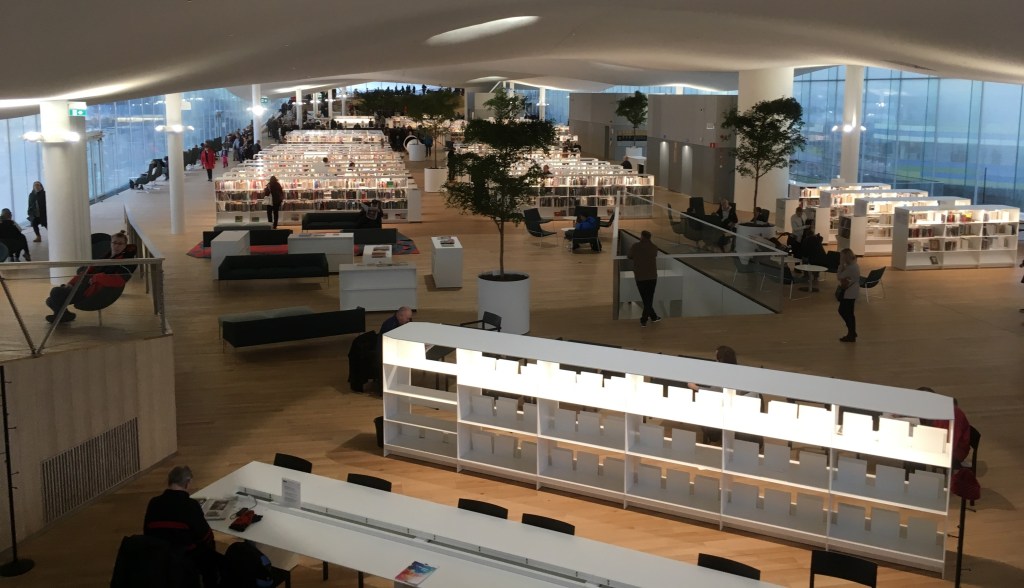
Libraries are an important part of social infrastructure in Finland. They are not the traditional quiet space with books. A Finnish library provides free access to borrowing not only books, but also power tools, musical instruments, laptop computers and other specialist tools. It is possible to reserve the use of 3-D and other specialist printers. Reserve a sound-proof room for practicing your musical instrument. There are plenty of spaces for study work and serious learning. There are usually dedicated play spaces for toddlers, a youth activity area with pool tables and computer gaming. Not forgetting the magazines and newspapers both physical and available on-line. My local library incorporated into the new Metro Station/shopping centre completed in 2023, always seems to be busy and provides a comfortable environment for all age ranges. Clever use of materials and textiles, curving book shelves and other design features makes the space feel spacious, yet homely. There are even comfortable arm chairs for reading. If you live in a nearby apartment block, this library must feel like another living room and continues the Finnish tradition of providing high quality and innovative public spaces. Another good example would be the main library, Oodi, in central Helsinki.
Social Support
Finns usually don’t mind paying tax in the knowledge that should hard times or sickness befall them, the state will take care of their needs. It is a progressive proportional tax system. You earn more and then pay a higher rate of tax. The homeless problem was solved by providing people who end up on the street with their own apartments and the support needed to start living a normal life. Four out of five that get the opportunity go on to live a successful life gaining work, and contributing positively to society. A leg up that works.
At present we have a right-wing Government with the belief that austerity must be imposed. However, many of the cuts they are making affect the poorest and vulnerable in society, breaking the status quo in this social democratic country. At the same time, stimulus for the economy has also been reduced. I am not hopeful for a successful resurge from economic stagnation but am sure that the next Government will be more Centre-Left.
 Happy in Finland
Leave a comment