
The London Olympics and the Queen’s Jubilee made 2012 a memorable year, and we got married and moved to Finland. Smart phones were becoming more common and affordable. The operating system competition between Apple’s OS, Google’s Android and Nokia’s Symbian were starting to fade. The decline for Nokia started in 2010 when manufacturers Sony Ericsson and Samsung decided to opt for Android and not Symbian. Then Nokia was slow to respond to what customers wanted and the partnership with Microsoft was not enough to stem the decline either. At one point, Nokia had been the largest manufacturer of communications devices in the world. In 2007 at the time of the Apple iPhone launch, Nokia’s Symbian operating system was enabling over 60% of devices worldwide. Nokia was the pride of Finland and a major employer.
Nokia’s Trajectory
The business started as a couple of papermills harnessing hydro-electric power from the river rapids located in the Finnish South midlands, in Tampere, and a small town called Nokia. A public limited company was formed in 1871 and Nokia Ab diversified into electricity production by 1902. Around the same time the Finnish Rubber Company was manufacturing rubber boots and other rubber products near Nokia, using the town’s name in their marketing. After the First World War Nokia Ab was near bankrupt and was purchased by the Rubber Company. Later in 1932 the Rubber Company also acquired the Finnish Cable Manufacturing Company and then the ingredients were all together to create the electronics company Nokia became.
Cold War Effect
To some extent the Cold War pre-empted the need for a radio-mobile phone network. Nokia started to develop this for the Finnish Defence Force and other commercial uses in the 1960s. The geography of Finland, a big, long country with a huge border with the Soviet Union and lots of trees. Telephone and electricity cables were very vulnerable to failure due to falling trees and storms. The military desired a system that could be used securely in all weathers and radio telephony came along so that by 1978 the whole of Finland was covered by a commercial mobile phone network.
The Fall
Nokia telecommunications took off during the last decades of the 20th Century and became a huge employer in Finland, Europe and Asia. However, by 2012 the decline of market share led to the start of large numbers of employees being laid off and by 2014 the mobile phone business had been sold to Microsoft. Nokia now operates in the communications network business, consolidating that with the purchase of Alcatel-Lucent a French telecommunications company. If you live in the capital region, it is fairly easy to bump into someone who works or used to work for Nokia. It was so big that the redundancies spawned many of today’s IT businesses in Finland. Although the Nokian rubber boots business is Finnish owned, the footwear is probably made in another part of Europe. The vehicle tyre manufacturing, now a separate company, still continues near Nokia.
Personal IT
My first smartphone was acquired during our first months of living in Finland. It had to be in my wife’s name because I was yet to acquire my own local bank account and get myself into the Finnish bureaucracy. For me the Nokia Lumia with the Microsoft operating system was really useful. A lifesaver, otherwise I might have gone crazy trying to survive without many language skills. The Nokia navigation got me from A to B reliably in the car and it was so very reassuring when travelling by public transport to see when to get off at your destination when you have never visited somewhere before. How ever did we manage before navigation apps? Prior knowledge or lots of detailed maps. Apparently, many folks hated the Microsoft system but for me I found that compared to my Android using companions I could access more information and the phone also kept working in cold conditions when others had given up.
Finn Electronic ID System
The banking identification system was something new I had to master. Not easy when it is only available in Finnish or Swedish. Once registered with the authorities and entered on the national database, the henkilötunnus (your identity number) arrives in the post and it then makes it straightforward to open a bank account with all the associated benefits, not just payments and savings. The banking system manages the internet security gateway for almost everything. It gives all citizens a secure way to sign into any website for secure use. Apart from the usual username and password, there is secondary verification by passcodes to your mobile phone. A breeze once setup and you know what you are doing. My dear fluent Finnish person guided me through the first few attempts on the laptop.
Using the System
One system for electronic sign-on for secure transactions makes life relatively straight forward. It makes no difference using a computer or your smartphone, the connection goes through 2 stage verification to prove your identity. It eliminated the need for paper cheques issued by people for bank payments years ago. It is extremely difficult to cash a cheque at a bank here, so please don’t send me any. Now that smartphones have advanced so much, more and more banking is done on-line. By using my phone I can see live exactly what is happening in my bank accounts. Companies send me electronic invoices for their services and the need for paper is eliminated. Business can set up their systems so that bank payments and receipts are automatically recorded in their own accounting records saving a lot of time. The only unfortunate side effect has been the closure of many bank’s retail premises, hastened by the invention of the cash paying-in machine. It can be difficult to see a real life banker, so far my little issues have been solved with a phone call, and I don’t see that as negative unless they keep me waiting on hold for too long. People still like the human touch and may be it will come full circle and banks will find a way for real customer facing services in the future, although during Covid with all these IT systems in place, life continued almost as normal.
Not only for access to your own bank accounts, the national banking identification system is used by businesses to verify your bank cards when paying on-line for services. It’s used to book appointments in the healthcare system, or anything needing verification of your identity. Our last house which we bought during Covid; the purchase was completed entirely on-line. We viewed the house in masks twice, reviewed the survey on-line and made the offer by email. The contracts were exchanged, verified electronically, monies transferred, and signatures made electronically. The house deeds are also all held electronically somewhere, and we have a copy on the home hard disk and a backup. All done and dusted within two weeks of making an offer.
The National Database
The biggest hurdle for any new immigrant is to obtain the Finnish National Identity number. You have to first prove your rights to residence gained by going through the Finnish Migration Service (Migri). Your residence can then be verified with the Police and then registered at the Magistrates Office to get entered onto the National Identity Register. You are then issued with your own ID number. Moving house in Finland is then relatively easy because you only need to notify the National Register of your new address and then all important authorities, banks and businesses automatically can get an update of the new address. The National Identity Register can be accessed by anyone, although not everyone can see addresses. I can reliably inform you that there are only two people with my surname living in Finland. All this data helps the Government plan where services are needed and makes more accurate future decision making. The Finnish Government Office of Statistics publishes the live current population number in bright lights above its Helsinki office. Further information can be found at www.stat.fi/en/statistics.
At Home and Away
The popularity of the old land line is in decline. Most Finnish households do not have a land line for the telephone. The 4 and 5G networks are usually very good across the whole country so folks no longer need a fixed line. Big cities are well equipped with fibre and cable connections but with the advent of 4G we only use a mobile router for our main internet connection at home with fallback of a smartphone as a hub if necessary. For my work I only use a smartphone for accessing everything. My work schedules are in an App, I can email and message all I need. The smartphone is my mobile office and only very very rarely is a lack of signal a problem.
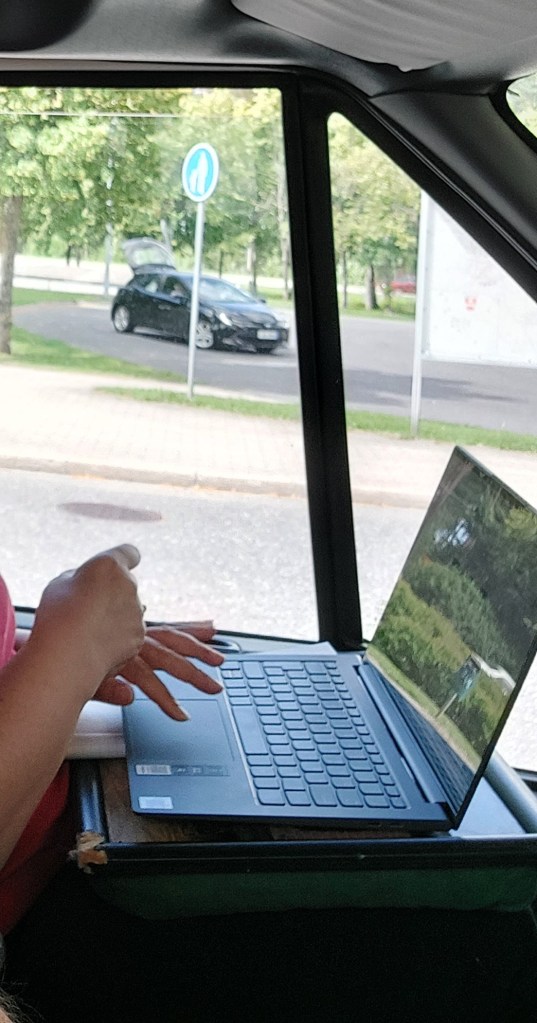
The mobile phone system across Finland is so good that my wife can work on the move. Whether in a train or sitting next to me in the car, or campervan, she can operate her business laptop as if at home or in the office, only without the comfort of her big monitor screens. The only disappointment comes when travelling abroad and the same level of connectivity is not available. Each year I visit the UK, things are improving but rural areas are still poorly serviced. Luckily at these times we are relaxed and on vacation.

 Happy in Finland
Leave a comment