
From the 1st of November to 31st March in Finland, tyres are required appropriate for the conditions, a legal requirement but also drivers will notice a huge benefit on snow using winter tyres. Summer tyres are made of harder rubber for better wearing characteristics in warmer weather and also have less aggressive tread patterns for longevity. This makes them very much less effective at temperatures below 5 degrees Celsius, for stopping distance and grip. Only once have I been caught out with summer tyres on the works van in late October and overnight snow. The main roads were clear of snow but slip roads off dual carriageways were still white, which made stopping a little panicky and heart stopping. Every year guaranteed, first snowfalls result in many rear end shunts while Finns remember it’s time to slow down, leave a larger safety gap and get the tyres swapped over.
Studded or No Studs
We have the choice of winter tyres with or without studs. All will be marked with the 3-mountain symbol showing that they are legal for winter use but studded or not comes down to personal choice and the likely weather conditions. Studs help an awful lot when driving on ice and hard packed snow. As the car brakes you can hear them getting louder as they dig in. In the South of Finland we often get temperatures wildly swinging from below freezing to a few degrees above, which results in lethal icy roads. Thus, most cars in the South are equipped with studded tyres. Further North where most of the time it stays below freezing, you are more likely to be driving on snow which at temperatures below minus 5 has a surprising amount of grip. Without studs, driving on asphalt is quieter, control and braking distances are superior. Therefore, if you are likely to be mostly driving on snow, stud free tyres are better.
Studded Tyres
Depending on the brand and how much you pay, there are around 150 to 300 small metal studs fixed into the tread. They protrude about 1 – 2mm from the tread surface to penetrate ice and assist the tyre to grip. It is worth paying for a quality winter tyre to have better quality studs that are likely to last. Hard braking and rapid acceleration on asphalt are the main causes of losing studs. The tyre must have at least 75% of the original studs evenly distributed to stay road legal in Finland. As winter tyres age (also stud free tyres) the rubber compound gets harder and this leads to less grip and the less flexible material means that studs are lost too. Recommendations are to buy new winter tyres if they are over 10 years old. When using studded tyres, corners need to be taken more slowly, even when on an ice free surface. The metal studs just skid over hard asphalt and braking distances are longer than rubber only tyres. Maximum speed should be limited to 100kph to avoid excess stud wear. Motorways have this as the maximum limit during the winter months too.
All Weather Tyres
These tyres are not the total solution for reducing the need to change wheels over. They are legal for winter use in Finland if they have the 3-mountain symbol. The rubber compound is softer than a normal summer tyre and will wear more if used throughout the hotter weather. They also do not have as short a stopping distance as that which can be achieved with summer tyres. I do use them on our four-wheel drive vehicle for better grip off road during the summer months. It also gives me the flexibility to change them for the studded winter tyres later in the Autumn or earlier in the Spring and not worry about a late frost or early winter snow. So far, they have lasted two summer seasons but now may be wearing below 3mm and will not be legal if it snows.
A final tyre alternative is to use stud free winter tyres all year round. However, they will suffer excessive wear over the summer months and will need replacing more often. Some people do this to reduce wheel changes and like the advantage of the newer rubber of the younger tyres for the winter.
Road Wear
Road wear is a big issue in Southern Finland. It is easy to find worn ruts in the road particularly at traffic lights where drivers slip the clutch too fast on the slippery winter surfaces. In the spring, overnight temperatures are likely to fall below freezing and the authorities keep major roads safe by spreading salt and grit. Then the road dust can be really bad in March and April. It can be so bad that clouds of it can be seen hanging over major routes. It’s formed by studs wearing the road surface and tyres grinding the grit that was applied during the icy conditions. It persists if the streets are not washed or we don’t have heavy rains. Towns and cities brush up the grit from roads and pavements to reduce the dust problem. Helsinki City council are trying to persuade more folks to use stud free tyres to reduce the dust issue. One central city major thoroughfare has studs banned in an attempt to quantify road wear and associated dust.
Wheel Changes
A car purchased in Finland should come with a second set of wheels ready to swap over depending on the season. If not, you need to purchase them, this may affect what you want to offer when buying the car or van. Late October everyone thinks about changing wheels over for winter. Tyre depots take on extra staff to cope with demand, which is high after an early snowfall. Pop-up wheel change locations appear so there’s plenty of competition, and prices start at €25 for all 4 wheels. Most big tyre depots offer the Tyre Hotel service. For an annual fee they change over and store your spare wheels until you next need them. Without the hotel service, you will need a place to store your own wheels. Most houses and apartments usually have somewhere but it needs to be exclusive to you to prevent theft. Some of us more mechanically minded like to change over our own wheels. A small trolley jack, a socket set, a telescopic handle for your socket, and a reasonably level hard standing is all that’s required. It takes 20 to 30 minutes, and you can check the vehicle brake pads at the same time, not forgetting to check the tyre pressures after months in storage.
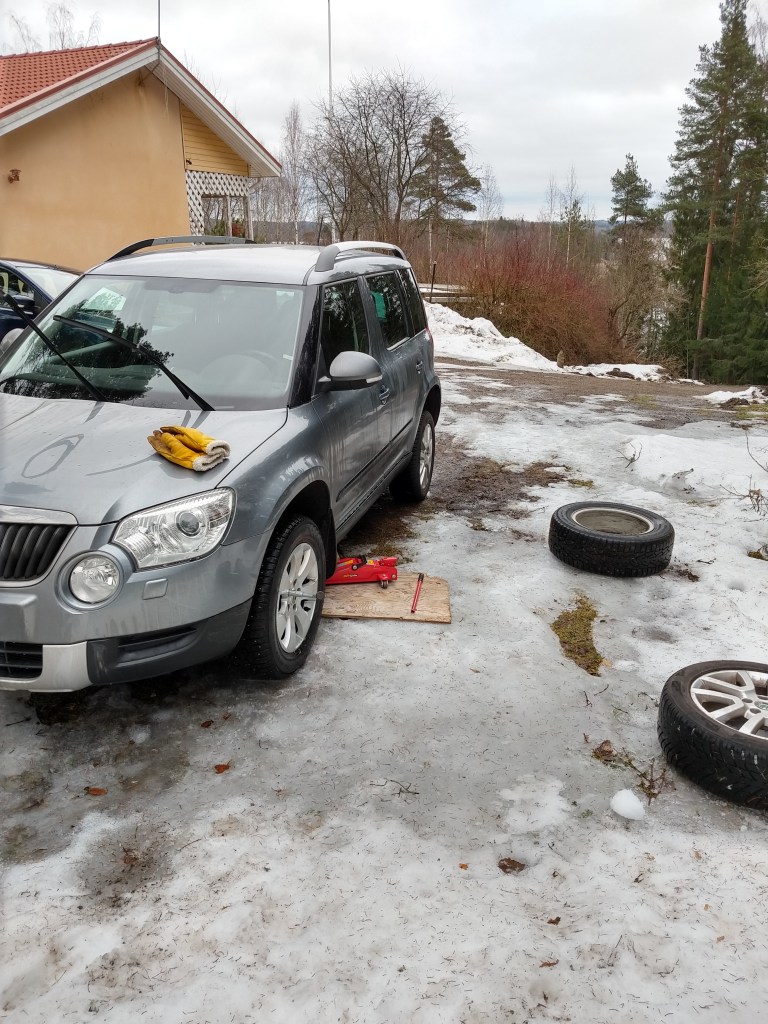
Those drivers that are likely to catch the ferry to drive further South should also remember that studded tyres are allowed in Sweden and Estonia but not in Germany and beyond. Studs seem to be a Nordic thing. Driving on summer tyres after a long cold winter feels so liberating. The vehicle’s good handling returns and the speed limits are increased for summer time. Back to 120kph on the motorway.
Note for Living in Finland: If you need a tyre depot to change over your wheels, many offer an on-line booking service which saves waiting in a queue. Alloy wheels should have the wheel nuts checked for tightness after about 100km of driving. Whatever winter tyre you select, the law requires a minimum tread depth of 3.0mm for winter and 1.6mm for summer.
 Happy in Finland
Leave a comment