
Coping with a long Finnish winter is mostly about mindset and preparation. Of the two, being properly prepared is important and also helps the mindset. October is the month for getting ready for winter and not just admiring the misty mornings and leaves falling. Since moving to Finland, I have got into a winter preparation routine each autumn. Hopefully, it will have been dry enough for the lawn to be cut for the last time and the mower safely stowed away.
October – Get Ready
Items vulnerable to frost are brought inside. The hose pipe, water pumps and related devices drained and put away. One winter I left a trigger operated hosepipe watering gun out and the immense power of expansion, as the water froze, split the plastic in half making it useless the following spring. A rummage in our outside storage shed follows to retrieve all my tools. The wood plane, chisels, saws, and electrical hand tools need storing in a warm dry place, because the outside winter temperatures fluctuate so much that any humidity turns ferric metal to rust. Maybe I am a little too organised because I also swap my wardrobe around. Winter clothes stacked on lower shelves and summer shirts stashed away in a less accessible top cupboard only. The boot rack reorganised to put the winter footwear to the fore and summer sandals and shoes stashed away. Most Finnish houses have ample storage near the front door for all these different boots and coats. The only things left to do may be replacing a light bulb that I noticed missing in the diminishing daylight, change the wheels, swapping over to winter tyres, and put the winter stuff inside the car. Extra winter stuff includes the snow brush and ice scraper, the auxiliary electric heater, and a small shovel just in case the car needs digging out of a parking spot.
Community Tidy Up
In Finland we have “Talkoot”, where neighbours get together for tending the communal gardens and yards. Our group of houses organises one both Spring and Autumn. A Saturday in October we will be all sweeping up leaves, raking lawns, and trimming hedges. There are some keen gardeners amongst us and over the summer the compost heap and clippings pile usually gets to over flowing, so one of the biggest jobs will be to carry it all to the skip that’s hired to take away the bio-matter for recycling. Usually all the tasks are complete by lunchtime so then Talkoot becomes an excuse to grill sausages, have a few beers and get to know the neighbours. Talkoot really saves us all higher service charges and we get the opportunity to shape how the neighbourhood looks.
In October the authorities put up the bright coloured markers to guide the snow ploughs. These bright orange sticks with reflectors are inserted into kerbs to mark road edges. Some councils use off cuts from spruce trees to mark the road edges, and they look like a lot of small Christmas trees erected early. A sure sign winter and Christmas is coming.
Snow Moving
Apart from the centres of old cities and towns, the pavements (sidewalks) are designed to be wide enough to allow mechanical snowploughing. That is, wide enough for a tractor with a snowplough blade. When the snow comes the main roads are cleared first in the early hours of the morning but it’s not long before the pavements and cycle tracks are also cleared. Grit may be spread on pedestrian areas where there is a danger of ice. Salt does not melt snow and ice in temperatures below minus 6 and is used sparingly and only on main routes.
Normal life rarely stops in Finland due to snowfall. A heavy fall of over 10cm in a morning may cause traffic to slow down so it’s best to allow more time for journeys. In the South we do get temperatures at below minus 20 for a few days but only a few busses and trains get cancelled due to such cold. Some tough folk continue bicycling with their extra layers of clothes and studded tyres.
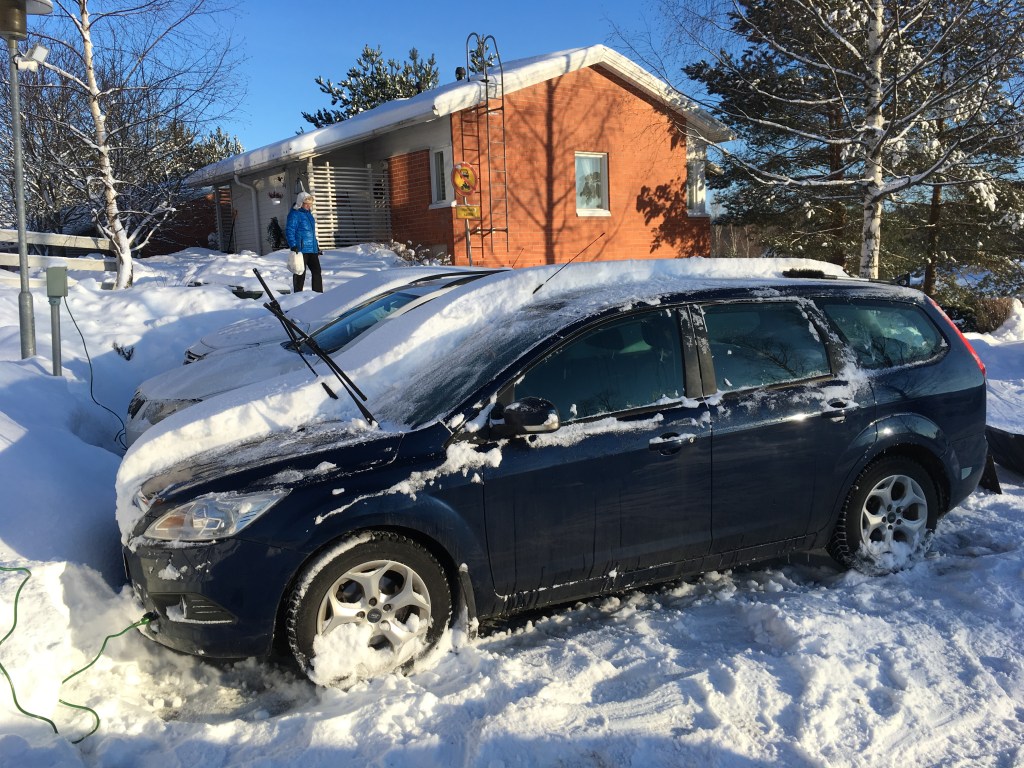
At home the paths need clearing of snow. Snow falling in temperatures below minus 5, is light and fluffy, it is easier if it’s moved before walking on it. Compacted snow is difficult to shift. It’s also better to remove as much snow as possible from paths just in case it melts and re-freezes as more slippery ice. Vehicles parked outside will also need snow moving. The Police don’t like to see mobile igloos on the road. The snow needs clearing for visibility, not forgetting registration number plates and lights, apart from clearing the roadway to drive out. If it snows day after day, this can be an adventure to start with but after weeks of snow, can get a little tedious. It takes about 10 to 20 minutes but it’s time the car can be warming up, remember to start the engine first. At allocated parking spaces we pay for the use of a special electrical socket. We can plug in the car for heating up ready to go. The vehicles are winterised with a heating element inside the engine cooling system and a cabin socket for a small heater. The timer can be set so that the vehicle can be pre-heated for 30 minutes or so and then the engine starts even in minus 20. Heated seats are fairly common and very nice in the very cold weather.

Note for living in Finland: Do not assume all snow is fluffy and soft. The ploughed banks on the sides of roads are rock solid and can damage you and your vehicle very easily. It may look like a deep snow field, great for a soft and fluffy landing but underneath may be rocks, lumps of ice, or a hard layer where the snow previously melted. At temperatures near freezing point the snow gets more slippery and dangerous.
 Happy in Finland
Leave a comment