
Sitting in the middle of a cold snowy winter it’s hard to imagine Finland will ever be warm again. Time for thinking about next summer’s activities and reminisce about the long hot days of previous years. One summer I cycled each day to work, about 6 kilometres. It was cheaper than going by bus and taking the direct route across Espoo’s Central Park it was a pleasant journey of under 20 minutes. The same journey by bus was 30 minutes with one change plus the walk to the stop, so I could leave home later by bike and arrive before the bus and in plenty of time. Instead of sitting down on the bus I got exercise, especially with the couple of short steep hills providing a little more physical exertion. As I crossed over the busy Ring II road, I had that smug feeling while looking down on the traffic snarled up and stopped each morning and afternoon in the rush hours.
Cycling in Espoo and Helsinki is particularly easy and safe with the many cycle tracks and paths that keep bikes from mixing too much with the bigger road users. With a few extra layers clothing and studded bicycle tyres, some tough people even cycle all year round. The majority wait for the snow and ice to disappear. For pleasure on one of those very hot summer days, I cycled from Espoo into central Helsinki. Having a bike in town makes popping from one place to the other very quick and easy. Hence the popularity of the yellow city hire bikes which appear to be everywhere. Along the Baana cycle route running through the old railway cutting, I noticed that there was an electronic display board that counted the number of passing cyclists. At 11.00 on a Friday in July, it showed that there were 1163 cyclists so far that day, 4571 for the week and a total of 474577 for the previous 12 months. That’s only one route into central Helsinki but it gives a good appreciation of how popular cycling must be in the capital region.
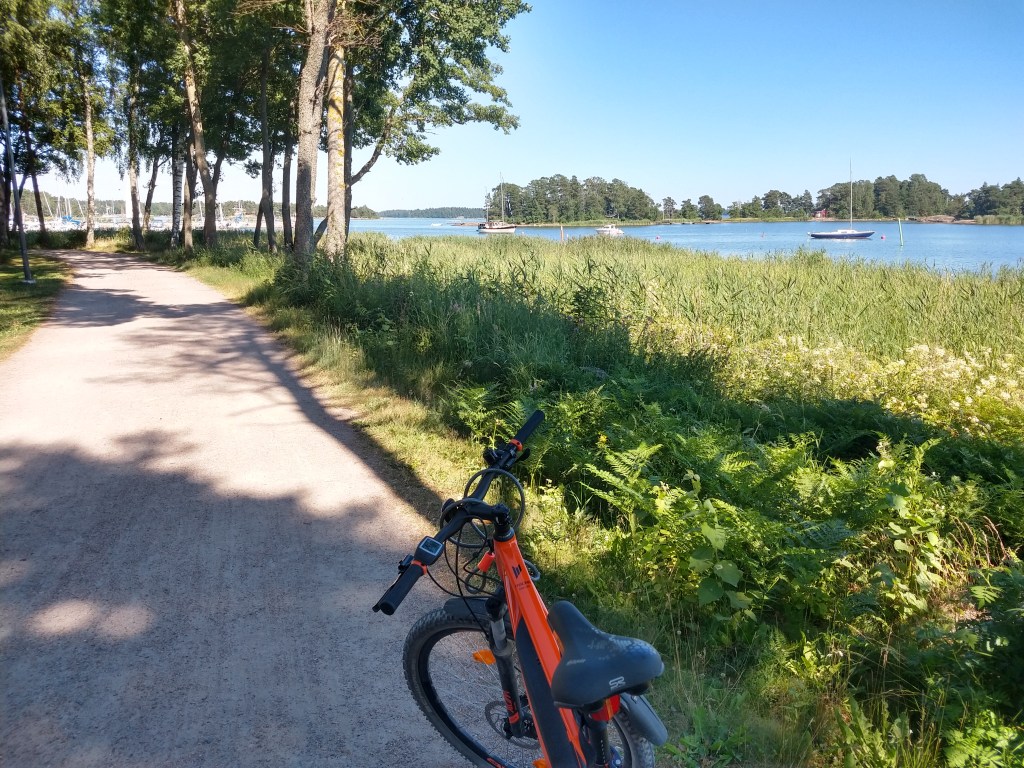
Much more noticeable last summer was the number of electronic bikes on the road after being silently overtaken by folks not even breaking into a sweat. At the beginning of 2018 the Finnish Government was contemplating tax breaks for those who buy an e-bike for commuting to work. The proposal got nowhere but e-bikes still appeared, even though the most basic models cost around €1000.
Which e bike to buy? At the first bicycle shop that I visited; they recommended finding an electric bike that feels comfortable for you as you would for a normal bike. Sitting positions vary and so does the action and assistance offered by the electric motor. Most commuter e-bikes have a battery capacity of 500 Watt hours and customers had reported regularly travelling 70 to 80 km for each battery charge. Some manufacturers suggest that in economy mode over 120km is possible but that’s probably only in ideal conditions traveling on the level. Apparently, all e-Bikes feel slightly different when in use. Motors can be inside the wheel hub or as part of the pedal crank case. Hub motors seem to be less popular. Mounting the motor on the pedal crank keeps the centre of gravity low and applies the power and torque in the best place to assist the human input.
I tried out a Scott bike which provided a comfortable riding position for me and I was pleasantly surprised by the ease of pedalling even without any electrical assistance. In only ‘eco’ mode, the amount of assistance given by the Bosch motor was pleasing. I appreciated the thought of stress-less up-hill cycling and arriving at work cool and fresh. It’s easy to see why e-bikes are becoming popular. The shops I visited recommended an annual service, although all the models I looked at had disc brakes and so few wearing parts. Spokes may need tightening, brakes may need adjusting to the optimum because you may be travelling everywhere faster. Also there may be software updates that will keep the motor and battery working as efficiently as possible. Most of the e-bikes I saw had Derailleur gears which are easy to maintain but are exposed to the elements. Having a motor means that folks tend to forget to use the gears and allow the electrical assistance to do the work. However, this leads to just one or two of the gears being used all the time and they can wear to the point of being completely stripped. Maybe eight gears in a hub would be enough. I tested the Helkama model with an automatic Shimano Di2 eight gear hub system. Without any motor assistance the bike was easy to pedal along on the level, eco-mode gave pleasing easy cycling even up-hill and normal mode used very little leg effort. High mode made the steep hills really easy and the gearbox clicked away changing gear to suit the steepness of the incline or my speed, just like an automatic car.
Eventually I succumbed and purchased a KTM mountain e-bike which is practical for both on and off road commuting and leisure. I travel further and faster without breaking into a sweat for the hills and can easily keep up with my younger cycling companions.
Note for living in Finland: Many of the cycle tracks are sand based for ease of maintenance, hence a wider tyre travels best. A folding bike can be carried onto city buses. There are special carriages for bikes on the commuter trains and metro. If travelling by train further afield, space needs to be booked on the inter-city trains with a small fee. Unless signage says otherwise, it is not illegal to cycle on the pavement (sidewalk) in Finland. If the path is very busy with pedestrians or very narrow, common sense should prevail and the cyclist moves to the road. Cycle theft is a problem especially in certain areas of Helsinki. You will need secure storage and heavy duty locks for that expensive bike. Most cyclists wear a helmet even though it is not mandatory.
 Happy in Finland
Leave a comment